

Share the plumbing.Never share the personality.
Two storefronts, one connected backbone. Both retail brands share a login, a commerce backbone and the AI orchestration layer underneath their valuation tooling. The auction marketplace is a separate business entirely — its own platform, own accounts, own everything — and shares none of it.

Great multi-brand work is restraint. Share the plumbing, never the personality. Every decision in this ecosystem came back to that.
Two storefronts, one component system.
Both storefronts are built from a single shared component system on a modern Vue framework. Deployed through git-integrated continuous delivery to a global edge network: every merge produces a preview, releases are atomic and instantly reversible.
One Login for the Portfolio
The authentication layer is deliberately brand-neutral: customers register once, and the account dashboard lets them view activity across the whole portfolio or toggle to a single store. Because attribution lives in the data layer rather than in the interface, the unified order history is not a merge job or a nightly sync. It is simply a brand-aware query against data that was structured correctly from the start.
Duplicate accounts, split history, one relationship treated as two.
One dashboard, a store toggle, and store attribution on every order.
The payoff compounds. A third retail brand joins the platform as a routing rule, a theme, and a catalog, not as a new engineering program.
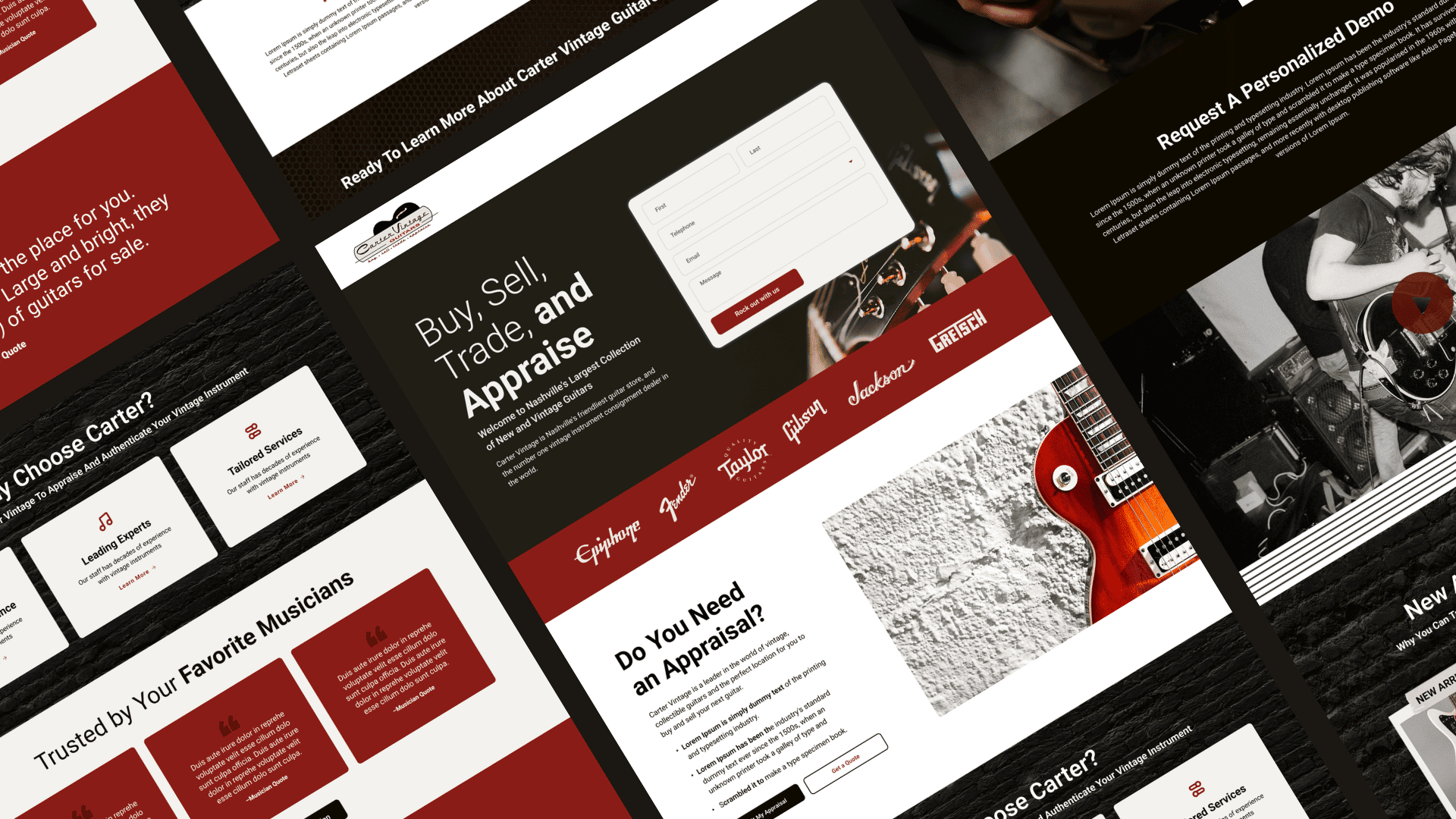
The unified account and commerce platform.
An auction business, built from a blank page.
Pyxl led strategy, information architecture, UX/UI design, brand identity, and full-stack development of the client's new auction-based marketplace: a premium, mobile-responsive platform purpose-built for high-value instrument sales. Auction commerce is not standard eCommerce, and the backend reflects it. Each module owns its domain logic, so the platform can evolve one capability at a time without destabilizing the rest.
A high-value marketplace lives or dies on trust, so the trust architecture got particular attention.
Hardened authentication
Token-based authentication with rotating refresh credentials and hardened password storage, plus one-tap OAuth sign-in.
Verified counterparties
Seller onboarding with built-in identity verification, so buyers bid against verified sellers.
Marketplace-grade payments
Multi-party payments with escrow logic, built for marketplace money movement: funds are held, split, and released as transactions complete.
Integrated shipping
App-native transactional notifications keep buyers and sellers informed at every stage without leaving the platform.
Above the backend sits the full product Pyxl designed: an auction engine with real-time bidding, watchlists, and countdown logic; tiered instrument submission workflows; administrative tools for approvals, disputes, and reporting; a complete brand identity from style tiles through final guidelines; and a companion mobile application designed to mirror core platform functionality. This is not a feature bolted onto the retail site. It is a second business, launched with the trust architecture and operational tooling a high-value marketplace demands.
An internal tool, running on borrowed time.
Staff used it every day to price instruments. The infrastructure underneath it was not going to survive. We optimized it for speed and accuracy and built an AI orchestration layer underneath — first-party retrieval, live market data and telemetry — so it kept working when the model underneath it changed.
The tool streams results in real time as staff work. Dashboard insights feed prompt refinement and data weighting, back into the core.
Migration Under Deadline
Pyxl moved the tool off the provider’s deprecated agent framework and onto a long-term supported platform ahead of the announced sunset, with no interruption to the staff who rely on it daily. Streaming was treated as a hard requirement: staff watch the valuation compose in real time rather than staring at a spinner.
No Longer a Black Box
Every interaction becomes an event: the query, the comparables retrieved, the tools invoked, the answer given. The analytics dashboard covers search frequency, popular instruments, and valuation performance, and those insights feed directly back into prompt refinement and data weighting. It is an internal tool with telemetry.
The tool is not a script bolted onto a spreadsheet. It honors the same identity, draws on the same first-party pricing history, and emits events into the same analytics fabric as the rest of the platform. One ecosystem, one source of truth.
The room people fly to had never reported a number.
The North American Guitar’s showrooms are the heart of the business, so Pyxl built the connective tissue between the physical floor and the digital experience: a dynamic QR tagging system for in-store instruments. Each printed tag encodes a direct link to that instrument's live product listing, with campaign tracking parameters built in.
Instrument on the wall
Branded tag: specs on the front, provenance and story on the back.
Customer scans the QR
A clear scan call to action on every tag.
Live listing opens
Visit attributed through campaign tracking parameters.
Explore, save, or purchase
In-store interest becomes measurable online engagement.
Email journey begins
Post-purchase flows connect the visit to the CRM.
Tags are generated directly from the inventory system, so the program scales with the catalog instead of requiring manual work per instrument.
Attribution is baked into every code, connecting in-store interest to web analytics and the client's CRM.
Floor browsing used to be invisible. Now a scan on the showroom wall lands in the same attribution fabric as every click on the site.
A platform nobody markets is just an expense.
Technology alone does not grow a retail business, so Pyxl also built the marketing systems that put the platform to work. The engagement began with a focused foundation build, then shifted into ongoing strategy and optimization.
Built on reusable branded templates the group’s internal team can run independently.
The Foundation
- A multi-step abandoned cart workflow: triggers, copy, branded design, workflow logic, and pre-launch QA.
- A welcome email series for new contacts and customers, sequenced and tested before launch.
- A reusable branded master email template and a conversion-focused landing page template.
Ongoing
- Campaign planning aligned to the promotional calendar, including seasonal and inventory-specific campaigns.
- Behavioral segmentation, lifecycle nurturing, and continuous A/B testing across subject lines and conversion elements.
- Full attribution design connecting social, email, website, and sales, plus paid media strategy and management.
The division of labor is deliberate. The North American Guitar keeps full control of content, community, and the artist relationships that define the brands. Pyxl owns the strategic infrastructure underneath.
The lifecycle program in production.
It started with one website.Nobody scoped the rest.
What began as looking after one brand’s storefront is now a commerce backbone, an auction marketplace, an AI product and a unified account layer. Seven phases in, the scope is still expanding, and none of it was scoped in advance.
- Two established retail brands sharing one commerce backbone and one account experience, identities intact.
- A premium auction marketplace, designed and built end to end as its own separate business — own brand, own platform, own accounts, sharing nothing with the two retail brands.
- An internal AI valuation tool optimized for speed and accuracy, with a new orchestration layer and telemetry underneath it.
- A repeatable bridge between showroom inventory and the web.
- Marketing automation and attribution infrastructure that compounds over time.
Phases of an expanding engagement. No dates or durations implied.
Questions we getbefore the first call.
What was the problem?
A one-of-one inventory where every instrument is genuinely unique, sold across two storefronts, running on architecture that could not describe what a buyer was actually asking for. Conventional filters fail when no two products are the same.
What did Pyxl build?
One commerce backbone across the portfolio, HubSpot Enterprise across four hubs synced bi-directionally with a proprietary inventory system, and retrieval-augmented search on top so a customer can ask for what they want in a sentence rather than narrowing a filter set.
How long did it take?
Ninety days from kickoff to live sales and marketing automation, including an acquisition absorbed onto the same backbone without a rebuild.
Can you do this for a catalog like ours?
If your products are difficult to describe with filters — unique inventory, deep variant structures, or a catalog that changes weekly — this is the pattern. The retrieval layer is built over your own product data, so it describes your catalog rather than a generic one.